标签: Europe

欧洲

  • European officials welcome progress in talks on US proposals to end Russia-Ukraine war

    European officials welcome progress in talks on US proposals to end Russia-Ukraine war

    European officials expressed cautious optimism on Monday regarding the recent Geneva talks on a U.S.-proposed peace plan for Ukraine, acknowledging progress while emphasizing that significant challenges remain. The discussions, held in Switzerland, centered on a 28-point proposal presented by the United States, which has sparked concern in Kyiv and European capitals due to its perceived favoritism toward Russia. The plan reportedly urges Ukraine to cede territory to Moscow, reduce its military size, and abandon aspirations for NATO membership—a contentious point given NATO’s previous commitment to Ukraine’s eventual inclusion.

    Finnish President Alexander Stubb described the negotiations as a ‘step forward’ but highlighted unresolved issues in a post on social media platform X. Ukrainian President Volodymyr Zelenskyy, facing mounting domestic and military pressures, welcomed the diplomatic efforts, calling them ‘very good.’ However, the path to peace remains fraught with uncertainty. Kremlin spokesperson Dmitry Peskov noted that Russian officials had yet to review the revised plan and confirmed no immediate plans for further U.S.-Russia talks, though Moscow remains open to dialogue.

    German Foreign Minister Johannes Wadephul praised U.S. Secretary of State Marco Rubio’s role in the talks, particularly his efforts to address European and Ukrainian concerns. Rubio described the discussions as the most productive in ‘a very long time,’ expressing optimism about reaching a resolution. Meanwhile, Turkey continues to mediate between Russia and Ukraine, with President Recep Tayyip Erdogan set to discuss the 2022 Black Sea grain deal with Russian President Vladimir Putin. The agreement, which allowed Ukraine to export grain safely, collapsed last year after Moscow accused the West of failing to honor related commitments.

    Despite diplomatic efforts, the war’s grim reality persists. Russian drone strikes on Kharkiv, Ukraine’s second-largest city, killed four people and injured 13, including children. The attacks damaged residential buildings, an educational facility, and power lines, underscoring the ongoing humanitarian crisis. Ukraine’s air force reported 162 Russian drones fired overnight, with Romania scrambling fighter jets in response to incursions near its border. The juxtaposition of diplomatic progress and relentless violence highlights the complex and fragile nature of the conflict.

  • ‘No one will support it’: Ukraine’s soldiers react to US peace plan

    ‘No one will support it’: Ukraine’s soldiers react to US peace plan

    Ukraine’s frontline soldiers have expressed a range of emotions—defiance, anger, and resignation—in response to the draft US peace proposals. The BBC gathered insights from several soldiers via social media and email, revealing a deeply divided reaction to the plan, details of which were leaked last week. American and Ukrainian negotiators have since been revising the proposals, with ongoing discussions about the ‘peace framework.’

    Yaroslav, a soldier in eastern Ukraine, criticized the plan as ‘sucks… no one will support it,’ while an army medic with the call sign Shtutser labeled it an ‘absolutely disgraceful draft of a peace plan, unworthy of our attention.’ However, another soldier, Snake, argued that ‘it’s time to agree at least on something.’

    The US proposal comes as Russia makes significant battlefield advances, with Ukraine losing 450 sq km in the past month alone. Kyiv still controls about 15% of the Donbas region, a key war goal for Russia. The US plan suggests Ukraine cede the entire region, including areas it has defended for nearly four years. Snake commented, ‘Let them take it… We’re not fighting for the people but for the land, while losing more people.’ Andrii, an officer in Ukraine’s general staff, acknowledged the proposal as ‘painful and difficult’ but suggested Ukraine may have no alternative.

    Ukraine has defended the Donbas since 2014, when Russia annexed Crimea and its proxy forces seized parts of the region. Andrii noted, ‘We may not want to give it up, but we won’t be able to hold it by military force and resources.’ Matros, a soldier since 2018, argued that relinquishing the Donbas would ‘nullify everything—all the efforts of the armed forces’ and ‘disregard the lives of fallen soldiers and civilians.’

    The US draft also proposes limiting Ukraine’s armed forces to 600,000, down from the current estimate of over 800,000. Snake questioned the need for such a large peacetime army, stating, ‘What’s the point of having so many people in the army if there will be security guarantees?’ Andrii agreed, emphasizing that Ukraine’s economy would struggle to sustain such forces post-war.

    However, Shtutser and Matros opposed the reduction, with Shtutser calling the army ‘the only thing separating us from defeat and enslavement.’ The plan rules out Ukraine’s NATO membership but not EU membership, offering US security guarantees if Russia attacks again. Yevhen, a drone operator, supported the UK and France’s ‘Coalition of the Willing’ to provide a ‘reassurance force’ in Ukraine.

    Andrii expressed skepticism about Europe’s ability to offer security guarantees, stating, ‘Europe has turned out to be completely spineless and divided.’ Shtutser also doubted US guarantees under the current administration. The draft proposes fresh elections within 100 days post-war, a move supported by soldiers like Snake, Marin, and Andrii, who called for a ‘complete reset of government.’

    Despite some support for elections, the overall sentiment among soldiers is one of exhaustion and skepticism. Andrii concluded, ‘If it stops the war, then it works for me.’

  • Optimism ahead of pope’s visit to Turkey for reopening of Istanbul’s Greek Orthodox seminary

    Optimism ahead of pope’s visit to Turkey for reopening of Istanbul’s Greek Orthodox seminary

    As Pope Leo XIV prepares for his inaugural international visit to Turkey, there is growing optimism about the potential reopening of the Halki Theological School, a Greek Orthodox seminary that has been closed since 1971. Located on Heybeliada Island near Istanbul, the seminary has long been a symbol of Orthodox heritage and a focal point in the struggle for religious freedoms in Turkey. The school, which trained generations of Greek Orthodox patriarchs and clergy, including Ecumenical Patriarch Bartholomew I, was shuttered under laws restricting private higher education. Despite legal reforms allowing private universities to flourish, the seminary has remained closed, despite repeated appeals from international religious leaders and human rights advocates. The momentum for reopening the seminary gained traction after Turkish President Recep Tayyip Erdogan discussed the issue with U.S. President Donald Trump in September, expressing willingness to ‘do our part’ regarding its reopening. Erdogan had previously linked the move to reciprocal measures from Greece to improve the rights of Muslims there. Renovation work is already underway at the seminary, with completed clergy quarters and classrooms standing ready to welcome students. During his visit to Turkey, starting on November 27, Pope Leo XIV is scheduled to meet Erdogan and join Ecumenical Patriarch Bartholomew in commemorating the 1,700th anniversary of the Council of Nicaea, a key event in Christian history. Archbishop Elpidophoros, head of the Greek Orthodox Archdiocese of America, expressed optimism about the seminary’s reopening, stating that a committee of representatives from the Greek Orthodox Patriarchate and the Turkish government has begun discussions. He emphasized that keeping the school closed is a ‘political and diplomatic anachronism’ that hinders Turkey’s progress. The fate of the seminary is seen as a test of Turkey’s treatment of religious minorities, including its Christian population, which is estimated at 200,000 to 370,000 out of nearly 86 million. While Turkey’s Constitution guarantees freedom of religion, only Armenians, Greeks, and Jews are allowed to operate places of worship and schools, leaving other Christian groups without formal recognition. The reopening of the seminary could serve as a significant step toward improving religious freedoms and fostering cultural development and affinity between Greece and Turkey.

  • Navy intercepts two Russian ships in English Channel

    Navy intercepts two Russian ships in English Channel

    The UK Ministry of Defence (MoD) has reported that the Royal Navy intercepted two Russian warships, the RFN Stoikiy and the Yelnya, as they navigated through the English Channel. This incident marks the latest in a series of Russian naval activities in UK waters, raising concerns over escalating tensions. The HMS Severn, a River-class offshore patrol vessel, successfully tracked and monitored the Russian corvette and tanker as they passed through the Dover Strait. The MoD confirmed that the HMS Severn later transferred monitoring responsibilities to a NATO ally near Brittany, maintaining a vigilant presence to respond to any unexpected developments. This interception follows recent reports of the Russian spy ship Yantar using lasers to disrupt RAF pilots off the coast of Scotland, an act described by Defence Secretary John Healey as ‘deeply dangerous.’ Healey emphasized that the UK is fully aware of Russia’s actions and remains prepared to respond. He also highlighted a 30% increase in Russian vessels threatening UK waters over the past two years, attributing this to broader ‘Russian aggression’ impacting Europe. The RFN Stoikiy has previously been monitored by the Royal Navy, including in May when it was shadowed by HMS Hurworth and the 814 Naval Air Squadron. HMS Severn, commissioned in 2002, is part of the Royal Navy’s efforts to safeguard UK borders and monitor foreign warships. The MoD reiterated its commitment to defending UK waters and maintaining regional security amidst growing Russian naval activity.

  • UK navy intercepts Russian corvette and tanker as Moscow steps up naval activity

    UK navy intercepts Russian corvette and tanker as Moscow steps up naval activity

    In a significant escalation of maritime tensions, a UK patrol ship intercepted a Russian corvette and tanker as they navigated the English Channel, the UK Defense Ministry reported on Sunday. The HMS Severn shadowed the Russian vessels, the RFN Stoikiy and Yelnya, before transferring monitoring responsibilities to an unnamed NATO ally near Brittany. This incident underscores a 30% surge in Russian naval activity around UK waters over the past two years, according to official statements.

  • Bucha’s sense of betrayal over peace plan’s amnesty clause reflects a dark mood across Ukraine

    Bucha’s sense of betrayal over peace plan’s amnesty clause reflects a dark mood across Ukraine

    The Kyiv suburb of Bucha, scarred by mass graves and bullet-ridden churches, remains a haunting symbol of the brutality endured during Russia’s occupation. Now, its traumatized residents face a new source of anguish: a U.S.-led peace proposal that would grant blanket amnesty to the perpetrators of wartime atrocities. For the survivors of Bucha, where hundreds of Ukrainians were killed in 2022, the proposed amnesty is seen not as a path to reconciliation but as a betrayal of justice, fueling broader concerns in Ukraine about the implications of absolving Russian soldiers and officials of alleged crimes. The Church of Andrew the Apostle, still bearing the scars of war, stands beside a mass grave where civilians—some executed in the streets, others showing signs of torture—are buried. Father Andriy Halavin, the parish priest, warns that any amnesty would legitimize further violence as the conflict continues. “It’s a green light,” he said after a Sunday service. “It means you can keep bombing, keep executing soldiers, all with confidence that nothing will happen.” The mass killings in Bucha were uncovered after Russian forces withdrew following their failed attempt to seize Kyiv during the full-scale invasion in 2022. Father Andriy insists that justice is not about revenge but about proving accountability still matters, especially as Ukrainians grapple with painful trade-offs for peace. The proposed 28-point peace deal, reportedly the result of secret negotiations between Russian envoys and U.S. President Donald Trump’s administration, would require Ukraine to relinquish territory beyond what is currently controlled by Moscow, reduce its military, and abandon NATO membership. In return, Kyiv would receive international security guarantees and reconstruction assistance. At Bucha’s military cemetery, Vira Katanenko, 66, visited the grave of her son Andrii, who was killed in battle in the Donetsk region last year. For her, the peace plan and the proposed amnesty are unthinkable. “I can’t accept that,” she said. “They want forgiveness for all war crimes, including Bucha? That’s horrifying. Let them come here—let Trump himself come here. Let him and his family come, see our pain, and maybe then they’ll change their minds.” European leaders have emphasized that any peace talks must include Ukraine and protect its sovereignty. Ukrainian President Volodymyr Zelenskyy has described the plan as one of the war’s most challenging moments, pledging to work with Washington while seeking changes. Nearby, mourners gathered for the funeral of Ruslan Zhyhunov, a 41-year-old machine gunner killed in eastern Ukraine. The uncertainty surrounding the peace plan weighed heavily on relatives and neighbors as they watched the burial in the rain—a stark reminder of how fragile any promised future now feels. “How can you exchange the territory of your ancestors for something? For what?” asked Andrii Honcharuk, a 71-year-old retired territorial defense volunteer, who attended the service in uniform. “The war will not end soon. We will still be dying for a long time.”

  • Former Prince Andrew should testify in US investigation into Jeffrey Epstein, UK leader suggests

    Former Prince Andrew should testify in US investigation into Jeffrey Epstein, UK leader suggests

    LONDON — The pressure on Prince Andrew to cooperate with a U.S. congressional investigation into Jeffrey Epstein’s sex trafficking network has intensified following remarks by British Prime Minister Keir Starmer. While Starmer avoided direct commentary on the Duke of York’s case, he emphasized the importance of individuals with relevant information aiding investigative processes. ‘As a general principle, anyone possessing pertinent details should provide evidence to those who require it,’ Starmer stated during his visit to Johannesburg for the G20 summit.

  • Slovenians vote in a referendum on assisted dying for terminally ill patients

    Slovenians vote in a referendum on assisted dying for terminally ill patients

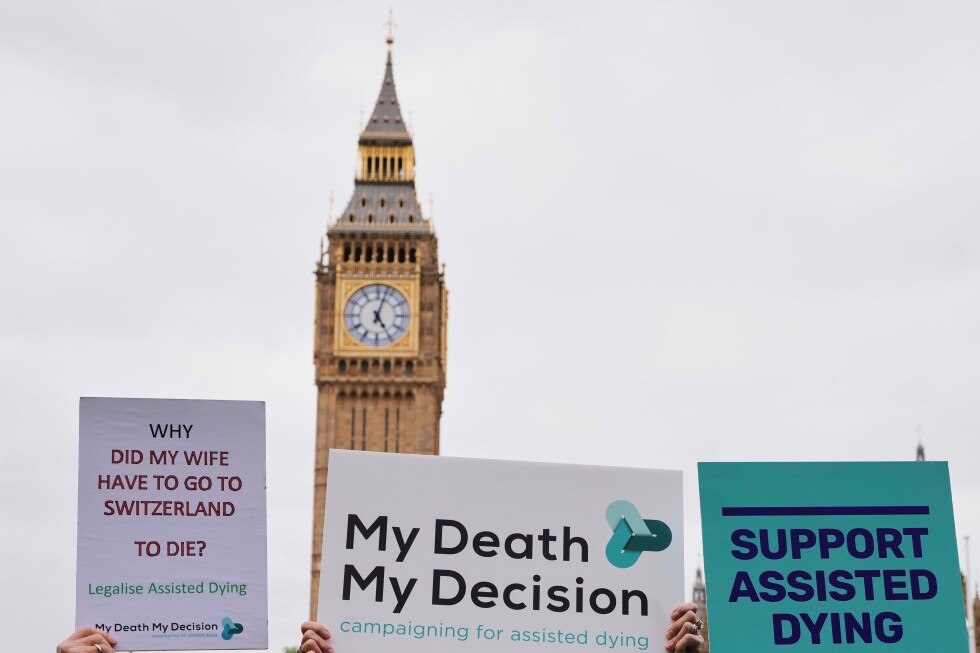
    In a pivotal moment for Slovenian society, citizens cast their votes on Sunday in a referendum concerning a law that would permit terminally ill patients to end their lives with medical assistance. The legislation, initially passed by the Slovenian Parliament in July, had previously garnered support in a nonbinding referendum last year. However, opposition groups, including conservative organizations, certain medical associations, and the Catholic Church, successfully petitioned for a new vote after collecting over 40,000 signatures. The law stipulates that mentally competent individuals with no prospect of recovery or those enduring unbearable pain may opt for assisted dying. Patients would self-administer lethal medication following approval from two physicians and a consultation period. Notably, the law excludes individuals with mental illnesses. Prime Minister Robert Golob’s liberal government has championed the legislation, emphasizing the importance of allowing individuals to die with dignity and control over their end-of-life decisions. Opponents, however, argue that the law violates Slovenia’s constitution and advocate for enhanced palliative care as an alternative. For the law to be overturned, a majority of voters must reject it, and they must constitute at least 20% of the 1.7 million eligible electorate. Recent polls indicate a slight majority in favor of the law. If upheld, Slovenia would join other EU nations like Austria and the Netherlands, which have already implemented similar measures.

  • Rubio is set to meet with Ukraine and its European allies over US peace plan

    Rubio is set to meet with Ukraine and its European allies over US peace plan

    Geneva witnessed high-stakes diplomatic discussions on Sunday as U.S. Secretary of State Marco Rubio arrived to engage with Ukrainian officials and European allies regarding a contentious U.S.-proposed peace plan for Ukraine. The 28-point blueprint, designed to end the nearly four-year conflict, has drawn sharp criticism from Kyiv and its Western supporters, who argue that the plan disproportionately favors Moscow despite Russia’s aggressive invasion of Ukraine. The Ukrainian delegation, led by President Volodymyr Zelenskyy’s chief of staff, Andrii Yermak, was joined by representatives from France, Germany, and the U.K., signaling a unified European stance against the proposal. The U.S. delegation also included Army Secretary Dan Driscoll and Steve Witkoff, President Donald Trump’s special envoy. The plan’s concessions to Russian demands, including territorial compromises, have been vehemently rejected by Zelenskyy, who has repeatedly vowed to defend Ukraine’s sovereignty. Speaking ahead of the talks, French Defense Ministry delegate Alice Rufo emphasized the importance of Ukraine’s ability to defend itself, labeling the plan’s restrictions on the Ukrainian military as a direct infringement on its sovereignty. Meanwhile, President Trump, speaking outside the White House, described the proposal as a step toward peace but clarified that it was not his “final offer.” The lack of clarity on Trump’s remarks and the White House’s silence on the matter have further fueled skepticism among Ukraine’s allies. The Geneva talks underscore the growing rift between the U.S. and its European partners over how to address the ongoing crisis in Ukraine.

  • Bosnian Serbs vote to choose president after separatist leader Dodik was removed from office

    Bosnian Serbs vote to choose president after separatist leader Dodik was removed from office

    In a pivotal moment for Bosnia-Herzegovina, voters in the Serb-dominated region of Republika Srpska headed to the polls on Sunday to elect a new president. This snap election follows the removal of Milorad Dodik, the former pro-Russian leader, who was ousted in August after a Bosnian court convicted him of defying the international High Representative for Bosnia. Dodik, who was sentenced to a year in prison and barred from public office, paid a fine to avoid incarceration and remains the leader of his Party of Independent Social Democrats. The election pits Sinisa Karan, Dodik’s chosen successor, against Branko Blanusa, a university professor representing the opposition Serb Democratic Party. Four other candidates are also in the race, though they are considered less competitive. Blanusa, after casting his vote in Banja Luka, emphasized the campaign’s fairness and urged a high voter turnout among the 1.2 million Bosnian Serb electorate. The election unfolds against a backdrop of deep ethnic divisions and political instability. Bosnia’s complex governance structure, established by the 1995 U.S.-brokered Dayton Agreement, divides the country into two entities: Republika Srpska, controlled by Serbs, and a federation shared by Bosniaks and Croats. Dodik, a long-time advocate for Republika Srpska’s secession from Bosnia, has faced international sanctions for his separatist policies. Although the U.S. recently lifted sanctions after Dodik agreed to step down, tensions persist with the international community, particularly with Christian Schmidt, the peace envoy overseeing Bosnia’s post-war stability. Dodik has actively campaigned for Karan, framing the election as a continuation of his political agenda. The outcome of this election could significantly impact Bosnia’s fragile political landscape and its relations with the international community.