
A highly organized hospital appointment scalping ring in Shenyang, China, has been dismantled by local police, revealing a sophisticated operation that exploited both technology and insider knowledge. The syndicate, which had been active for six months, allegedly stole over 7,500 appointments and amassed illegal profits exceeding 510,000 yuan. The group targeted desperate patients struggling to secure slots at top hospitals in the Liaoning provincial capital, where online appointments vanished within seconds and offline queues were interminable. The crackdown began in August when Shenyang police detected unusual activity in hospital registration systems. A month-long investigation uncovered a criminal network involving nine scalper gangs and 75 individuals operating a three-step scheme: snatch, hoard, and resell appointments. The gang’s methods were particularly insidious, with over 20 core members being former patients or caregivers who knew precisely when new appointments went live. To amplify their gains, the scalpers hired software developers to create plug-ins that hacked into hospital registration systems, allowing them to preset patient information and automatically snatch slots. These illegal tools were sold for tens of thousands of yuan, enabling some scalpers to earn between 10,000 to 20,000 yuan monthly. The gang operated like a well-oiled machine, with members specializing in various roles, from buying software to actively prowling hospitals for customers. Non-local patients, desperate to avoid delays, were hit with the highest markups, sometimes paying several thousand yuan extra. In September, a cross-region manhunt led to the arrest of all 75 suspects in cities including Guangzhou, Yantai, and Huludao. Ten suspects face charges of destroying computer information systems, while 65 others received administrative penalties. Following the bust, Shenyang police urged hospitals to upgrade their registration systems and monitor for abnormal traffic. Authorities are also using video patrols to spot scalpers early and have collaborated with internet firms to remove scalper ads, effectively cutting off their ability to find customers.
标签: Asia
亚洲
-

Retailer lauded for ‘moral-damage’ compensation
Pangdonglai, a prominent supermarket chain in Henan Province, China, has garnered widespread acclaim for its innovative approach to employee welfare by introducing a moral-damage compensation system. The company recently disclosed detailed records of payments made to employees whose personal dignity was compromised at work, highlighting its commitment to fostering a respectful and fair workplace environment.
-

Innovative vessel set to transform fisheries
Zhanjiang Bay 1, the world’s first floating, dynamically positioned cage-type aquaculture vessel, was officially commissioned in Zhanjiang, Guangdong province, on Wednesday. This groundbreaking vessel, developed by Jiangsu Dajin Heavy Industry Co., represents a significant leap in marine aquaculture technology. Designed for deep-sea operations, it combines floating aquaculture, autonomous navigation, typhoon avoidance, and green-energy self-supply capabilities. The vessel will operate approximately 30 nautical miles off Naozhou Island, initially focusing on pilot farming of large-sized yellow croakers, with plans to introduce golden pompano in 2026. Its success will determine batch-by-batch sales based on market conditions.
-
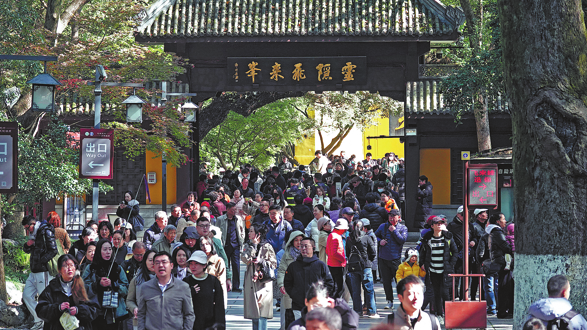
Hangzhou offers free entry to popular site
Hangzhou, a city renowned for its cultural heritage and scenic beauty, has announced that the Lingyin Feilaifeng Scenic Area will offer free admission to all visitors starting December 1, 2025. This decision underscores the city’s commitment to making its historical and cultural treasures accessible to everyone, reflecting a broader vision of cultural confidence and public welfare. The Lingyin Temple, a 1,700-year-old Buddhist site within the scenic area, is one of China’s most revered ancient temples, attracting millions of visitors annually. The move eliminates the 45 yuan ($6.32) entrance fee and the 30 yuan incense voucher, replacing them with a real-name reservation system to manage visitor flow. Experts view this as a significant shift from a ‘ticket-based economy’ to a ‘comprehensive economy,’ echoing the 2002 decision to make West Lake free to the public. This policy is expected to boost tourism-related industries, including dining, retail, and cultural products, while enhancing Hangzhou’s global reputation. Visitors have welcomed the news, with many expressing enthusiasm for the cost savings and increased accessibility. The decision also aligns with Hangzhou’s successful track record of leveraging free admission to drive economic growth, as seen with West Lake’s inscription on the UNESCO World Heritage List in 2011.
-

Child’s play
The Shanxi Grand Theater in Taiyuan recently hosted a vibrant open day event designed to introduce children to the captivating world of Chinese opera. Titled ‘Passing on Loyalty and Righteousness: Various Ways to Explore Guan Gong,’ the event seamlessly blended traditional opera performances with interactive modern elements, creating an engaging experience for young audiences. Guan Yu, or Guan Gong, a legendary figure from the late Eastern Han Dynasty, served as the central theme of the event. Known for his tales of loyalty and bravery, Guan Gong is a beloved character in Chinese opera and a household name across the country. The event featured children dressed in elaborate opera costumes, complete with makeup, performing alongside professional artists. This initiative aimed to foster an appreciation for traditional Chinese culture among the younger generation, ensuring that the rich heritage of Chinese opera continues to thrive. The Shanxi Grand Theater’s innovative approach to cultural education highlights the enduring relevance of traditional arts in contemporary society.
-

Japan OKs $135 billion stimulus package to help revive its sluggish economy
The Japanese Cabinet has greenlit a substantial 21.3 trillion yen ($135.4 billion) stimulus package aimed at revitalizing the nation’s economy and mitigating the effects of rising prices. Announced on Friday, this expansive fiscal measure underscores Prime Minister Sanae Takaichi’s commitment to aggressive government spending, despite concerns over its potential to exacerbate Japan’s already substantial national debt, which stands at approximately three times the size of its economy.
-

Men posing as India’s central bank officials pull off $800,000 heist
In a daring daylight robbery, armed men posing as officials from India’s central bank, the Reserve Bank of India, intercepted a cash-transport van in the bustling city of Bengaluru, Karnataka. The incident, which occurred on Wednesday afternoon, saw six men in an SUV stop the van on a busy road as it was transferring 70 million rupees ($800,000; £600,000) between bank branches. The van was carrying a driver, a cash custodian, and two armed security guards. The robbers, claiming to be RBI officials, demanded to verify the transport documents. They instructed the custodian and guards to leave their weapons in the van and enter the SUV, while the driver was told to continue driving with the cash. A few kilometers later, the gang forced the employees out of the SUV, returned to the van, and transferred the cash at gunpoint before fleeing the scene. The area had minimal CCTV coverage, complicating the investigation. Police are probing whether the gang used multiple vehicles and if the company employees were complicit. The SUV used in the heist had a fake number plate and a ‘Government of India’ sticker. Karnataka Chief Minister Siddaramaiah confirmed that the SUV has been recovered, but Home Minister G Parameshwara noted that the suspects likely switched vehicles to escape. Authorities remain confident in solving the case, drawing parallels to a recent high-profile gold theft in Vijayapura district, where 39kg of stolen gold was recovered and 15 individuals were arrested.
-

National games viewed as window to experience modern China
The 15th National Games, jointly hosted by Guangdong, Hong Kong, and Macao, have become a platform not only for athletic competition but also for showcasing China’s technological innovation and cultural integration. Held in Guangzhou and Shanwei, the event has drawn attention from cross-boundary visitors who were particularly impressed by the seamless integration of technology into everyday life.
Kinki Chan Tong-ieng, a Macao resident, visited Shanwei to support her son, Chan Man-hin, who was representing Macao in the sailing regatta. She was struck by the efficiency of facial recognition technology used for spectator check-ins and the convenience of mobile apps for real-time competition updates. ‘The process was smooth, secure, and incredibly efficient,’ she remarked.
Chan also highlighted the widespread use of technology on the mainland, especially in transportation and payments. ‘We used Didi for ride-hailing, which was transparent in pricing and quick to respond,’ she said, contrasting it with the limited availability of such services in Macao.
For Chan Man-hin, the games were more than just a competition; they were an opportunity to witness China’s rapid development firsthand. ‘I had the chance to interact with athletes from the mainland and Hong Kong, and their advice was invaluable,’ he shared. Despite the challenging sailing conditions, with waves reaching 2 to 3 meters, Chan emphasized the camaraderie among competitors and encouraged fellow Macao residents to experience such events.
The National Games have thus served as a window into modern China, blending sports, technology, and cultural exchange, leaving a lasting impression on participants and spectators alike.
-

A 5.5 magnitude earthquake in central Bangladesh kills at least 6 people
A moderate 5.5-magnitude earthquake rattled central Bangladesh on Friday, resulting in the tragic loss of at least six lives and injuring dozens more, according to local authorities. The tremor, which occurred at 10:38 a.m., was centered in the Ghorashal area of Narsingdi district, approximately 25 kilometers (16 miles) from the capital city of Dhaka. The U.S. Geological Survey (USGS) reported the quake’s depth at 10 kilometers (6 miles). In Dhaka, buildings swayed violently, prompting terrified residents to flee into the streets for safety. DBC Television, based in Dhaka, detailed that the fatalities included three individuals who perished due to the collapse of a building roof and a wall, and three pedestrians who were struck by falling building railings. While northern and southeastern Bangladesh are recognized as seismically active zones due to the tectonic interactions between the Indian and Eurasian plates, the central region typically experiences fewer such events. This rare quake has raised concerns about the region’s preparedness for seismic activity.
-

Ten photos from across China: Nov 14 – 20
The Shenzhou XXI mission marked another milestone in China’s space exploration efforts as its return capsule safely touched down at the Dongfeng landing site in Inner Mongolia on November 14, 2025. The capsule carried astronauts Wang Jie, Chen Dong, and Chen Zhongrui, who had completed their mission in space. This event was captured in a series of ten photographs showcasing significant moments from across China during the week of November 14 to 20. The successful landing underscores China’s growing capabilities in space technology and its commitment to advancing human spaceflight. The images, released by Xinhua, highlight not only the return of the astronauts but also other notable events and scenes from various regions of the country, reflecting the nation’s progress and diversity.