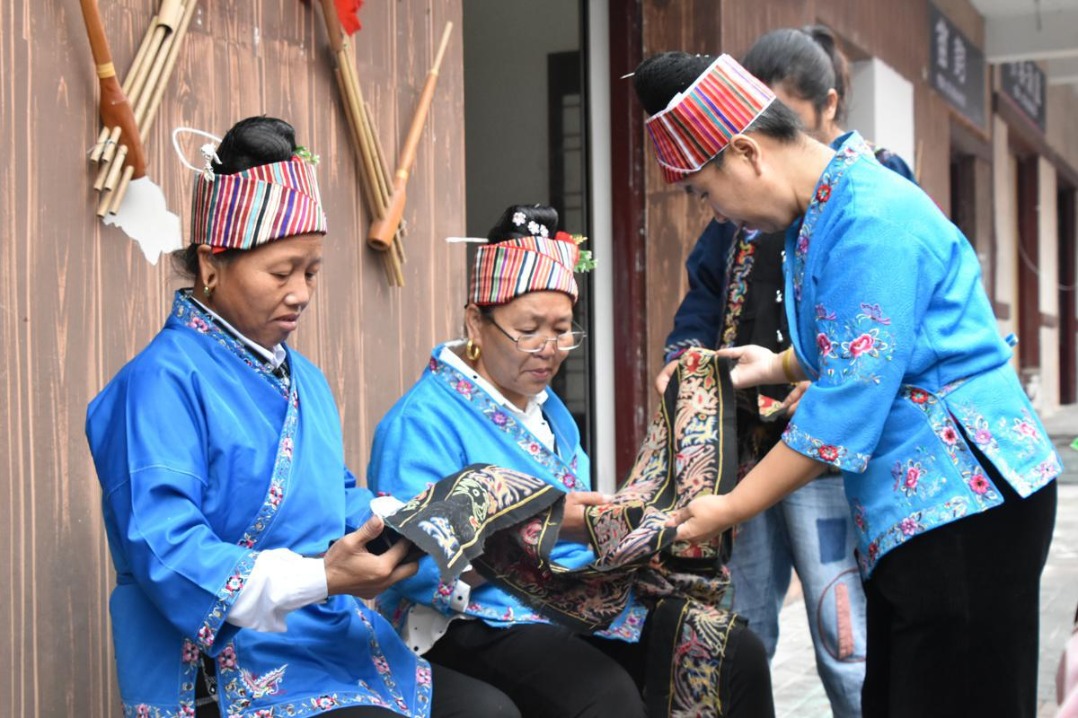
Wang Wanqiu, a 28-year-old student at the School of Visual Arts in New York, is revolutionizing the way traditional Chinese culture is perceived by integrating Miao embroidery with cutting-edge digital technology. Her project transforms intricate Miao embroidery patterns into digital collectibles, specifically Non-Fungible Tokens (NFTs), thereby preserving and promoting this ancient art form in the digital age. Inspired by her master’s program in Design for Social Innovation, Wang noticed a significant lack of Chinese cultural representation in New York’s diverse cultural scene. This observation led her to explore innovative ways to preserve and propagate traditional art forms through digital means. Collaborating with Luo Xianru, a classmate from the Tujia ethnic group, Wang aims to address the declining interest among younger generations and the financial struggles faced by traditional artisans. Their project not only highlights the beauty of Miao embroidery but also ensures its relevance in contemporary digital platforms. By converting these traditional designs into NFTs, Wang and her team are creating a new avenue for cultural transmission and economic sustainability for artisans. This initiative is a testament to the potential of digital technology in preserving and revitalizing traditional art forms, ensuring they are appreciated by future generations.
标签: Asia
亚洲
-

Return mission of Shenzhou XX crew progressing in an orderly manner
The return mission of the Shenzhou XX crew is advancing smoothly, marking a significant milestone in China’s space exploration endeavors. As of November 11, 2025, the mission is progressing in an orderly manner, reflecting the meticulous planning and execution by the China National Space Administration (CNSA). This mission is part of China’s broader strategy to enhance its capabilities in manned spaceflight and to contribute to global space research. The successful return of the Shenzhou XX crew will not only demonstrate China’s technological prowess but also pave the way for future missions, including potential lunar and Mars explorations. The CNSA has been closely monitoring the mission, ensuring all systems are functioning optimally to guarantee the safety and success of the crew’s return.
-

Calls grow for US to rein in Lai
Amid escalating cross-Strait tensions, Taiwan’s leader Lai Ching-te has come under increasing scrutiny for his radical militarist and separatist agenda. Experts suggest that Lai’s actions have placed him in an ‘all-or-nothing’ situation, with a growing chorus of voices in the United States urging Washington to rein in his provocations. Since assuming office last year, Lai has repeatedly asserted that Taiwan and the Chinese mainland are not ‘subordinate to one another’ and has pledged to increase the island’s defense budget to 5% of its GDP. This stance has drawn criticism from various quarters, including prominent US commentators. Thomas Friedman, a New York Times columnist, recently emphasized that the era of unconditional US support for Taiwan is over, urging the island to adopt a more cooperative and peaceful approach. His remarks, made during a seminar in Taipei, have reignited debates over the Democratic Progressive Party’s (DPP) strategy. Earlier, Time magazine labeled Lai as ‘reckless and brash,’ a characterization seen as a warning to the DPP leadership. Su Chi, a veteran Taiwanese politician, highlighted that the long-held belief in Taiwan that the US would ‘surely come to the rescue’ has been fundamentally shaken. He advocated for dialogue with the mainland to avoid conflict. A RAND Corporation report further suggested that the US should incentivize Beijing to pursue gradual approaches to its goals while stabilizing the region. Peng Qing’en, a spokesperson for China’s Taiwan Affairs Office, described Lai as a ‘troublemaker’ and a ‘peace disruptor,’ emphasizing the need to curb his provocations. Experts believe these developments reflect a more rational trend in US policy, driven by China’s growing national strength. Huang Ching-hsien of Nankai University noted that while major US policy shifts may take time, the discourse indicates the end of unconditional support for Taiwan. Zhu Guilan of Tsinghua University added that these voices reflect a pragmatic approach to risk management in light of China’s rising influence.
-

China’s car sales slow in October as some trade-in subsidies, tax breaks are phased out
China’s passenger car market experienced a notable slowdown in October, with even industry giants like BYD and Tesla reporting declines in sales. According to the China Association of Automobile Manufacturers (CAAM), year-on-year sales growth dropped to 4.4%, a significant decrease from September’s 11.2% and August’s 15.1%. This slowdown comes amid intense price competition in an already saturated market. However, the export of electric vehicles (EVs) and plug-in hybrids saw a remarkable surge, doubling from the previous year to approximately 250,000 units, as automakers increasingly target overseas markets.
-

Official confirms 8 deaths in Delhi blast
A devastating car explosion near Delhi’s historic Red Fort on Monday evening has resulted in eight confirmed deaths, with seven others injured, three of whom are in critical condition. The blast occurred when a slow-moving vehicle stopped at a traffic signal, triggering an explosion that ignited nearby vehicles and caused extensive damage. Emergency responders, including firefighters, police, and forensic experts, swiftly arrived at the scene to investigate the incident. India’s premier terror probe agency, the National Investigation Agency (NIA), and the National Security Guard (NSG) have also joined the investigation. Authorities have heightened security measures across the national capital, with Mumbai and other cities like Kolkata, Dehradun, Haryana, and Uttar Pradesh also on high alert. Indian Prime Minister Narendra Modi expressed his condolences, while Home Minister Amit Shah visited the hospital where the injured are being treated. Bomb squads and forensic teams are working to determine the nature of the explosives used and trace the owner of the vehicle involved in the blast.
-

New China-Laos bus link boosts ties
A newly launched international bus service between China and Laos has been widely praised for its efficiency, affordability, and comfort, marking a significant milestone in regional connectivity and bilateral cooperation. The service, which began trial operations on November 3, connects Mohan Railway Station in Yunnan province’s Mengla county with Boten Railway Station in Laos, covering a distance of just 16 kilometers in approximately 50 minutes. With five daily round trips, the route offers seamless customs clearance at both ends, significantly reducing travel time and enhancing convenience for passengers and business operators alike. For local residents like Ms. Li from Jinghong, the service has halved the time required to visit relatives in Laos, while Laotian timber trader Lintha Cheng highlighted its role in improving the safety and efficiency of cross-border business operations. The service, operated by Yunnan Tourism Co., integrates directly with the China-Laos Railway, creating a comprehensive transportation network that has already facilitated over 600,000 cross-border trips since the railway’s inauguration in December 2021. Officials and experts alike have lauded the initiative as a ‘bond of friendship’ and a ‘line of prosperity,’ with potential to invigorate the Mohan-Boten economic cooperation zone and deepen bilateral exchanges. The launch underscores the tangible benefits of institutional openness and coordination, paving the way for further small-scale cross-border projects and strengthening ties between the two nations.
-

Sri Lanka wins toss and fielding first against Pakistan in 1st ODI
In a strategic move, Sri Lanka won the toss and chose to field first in their one-day international (ODI) clash against Pakistan on Tuesday at the Pindi Cricket Stadium in Rawalpindi. Captain Charith Asalanka cited the anticipated dew factor later in the evening as the primary reason for the decision, believing it would favor the bowling side. The match marked the return of star leg-spinner Wanindu Hasaranga to the ODI format, alongside the debut of 24-year-old left-handed opener Kamil Mishara. Pakistan, led by new ODI captain Shaheen Shah Afridi, made a forced change to their lineup, replacing the unwell leg-spinner Abrar Ahmed, who had delivered a career-best performance in the previous match, with fast bowler Naseem Shah. In Abrar’s absence, Pakistan will rely on spin all-rounders Saim Ayub, Salman Ali Agha, and Mohammad Nawaz to bolster their bowling attack. Rawalpindi is set to host all three ODIs in the series this week, followed by a Twenty20 tri-series featuring Zimbabwe, Pakistan, and Sri Lanka. Pakistan enters the match with renewed confidence after securing a 2-1 series victory against South Africa last week, marking a turnaround from their earlier struggles in 2025.
-

Foreign envoys seek to share in China’s growth story
Foreign diplomatic envoys in China have voiced their optimism regarding the nation’s economic growth, expressing a keen interest in sharing the development opportunities arising from China’s modernization efforts. These sentiments were shared during a thematic briefing on the fourth plenary session of the 20th Central Committee of the Communist Party of China (CPC), organized by the International Department of the CPC Central Committee in Beijing on Monday. The fourth plenary session, held in October, saw the adoption of the Recommendations of the CPC Central Committee for Formulating the 15th Five-Year Plan for Economic and Social Development. The envoys highlighted their interest in China’s initiatives to expand domestic consumption, build a unified national market, and implement decarbonization policies, with a particular focus on Beijing’s foreign policy and efforts to enhance high-quality Belt and Road cooperation. Russian Ambassador to China Igor Morgulov emphasized the political significance of the CPC Central Committee’s recommendations, noting their alignment with Russia’s development plans and the strategic partnership between the two nations. Bangladesh’s Ambassador to China Nazmul Islam underscored the emphasis on high-quality development and technological innovation in the recommendations, expressing Bangladesh’s eagerness to learn from China’s development experience. Liu Haixing, head of the International Department of the CPC Central Committee, highlighted the 15th Five-Year Plan’s potential to open new prospects for China’s development and create broader market opportunities for the world. He reiterated China’s commitment to expanding its opening-up, promoting innovative trade development, and aligning with high-standard international economic and trade rules. The event was attended by diplomatic envoys from over 160 countries.
-

ROK’s Yoon indicted for additional charges of power abuse
In a significant development, former President Yoon Suk-yeol of the Republic of Korea (ROK) has been indicted on additional charges of “aiding the enemy” and “abuse of power.” The indictment was announced on Monday by Cho Eunsuk, the special counsel leading the investigation into Yoon’s alleged insurrection and other related offenses. The charges stem from actions that reportedly undermined the military interests of the ROK by escalating the risk of armed conflict between the two Koreas, allegedly to create conditions for declaring martial law.
Prosecutor Park Ji-young revealed that compelling evidence was found in a memo written by Yoon’s former counter-intelligence commander in October last year, which suggested efforts to “create an unstable situation or seize an arising opportunity.” Alongside Yoon, a former defense minister and a former counter-intelligence commander were also indicted on similar charges.
Yoon’s political career has been marred by controversy since December last year, when he attempted to subvert civilian rule by deploying armed soldiers to parliament to prevent lawmakers from rejecting his martial law declaration. This move plunged the ROK into a political crisis. Yoon was subsequently apprehended in January, indicted while in detention, and later released in March. However, he was taken into custody again in July.
The constitutional court upheld his impeachment on April 4, officially removing him from office over his failed martial law bid. The latest indictments add to the legal challenges facing the former president, who has yet to issue a public response.
-

Squid Game star, 81, acquitted of sexual misconduct
Renowned South Korean actor O Yeong-Su, celebrated for his role in the global hit series *Squid Game*, has been acquitted of sexual misconduct charges by a South Korean court. The 81-year-old actor was initially charged in 2022 with allegations of sexually assaulting a woman twice in 2017. The accusations claimed that he had hugged and kissed the woman on the cheek without her consent. In 2024, Mr. O was found guilty and handed an eight-month suspended prison sentence, which he vowed to appeal. However, on Tuesday, the court overturned the verdict, citing his completion of sexual violence education and raising doubts about the alleged victim’s memory due to the time elapsed since the incident. The court emphasized that ‘when there is doubt, the defendant must be given the benefit of the doubt.’ Despite the acquittal, the court acknowledged the possibility of the assault, noting Mr. O’s prior apology to the victim. The alleged victim, however, expressed disappointment, vowing to ‘continue to speak the truth’ and stating that the ruling ‘does not invalidate the truth or erase the pain.’ Women’s rights organization Womenlink also condemned the decision, calling it a ‘concealment of sexual violence in the theatre world.’ Mr. O, who gained international acclaim for his performance in *Squid Game* and became the first South Korean actor to win a Golden Globe for Best Supporting Actor, expressed gratitude for the court’s ‘wise judgment.’ It remains unclear whether the prosecution will appeal the decision.