
The Irish government has unveiled a series of stringent measures aimed at addressing the increasing number of asylum seekers in the country. At a high-level ministerial meeting in Dublin on Wednesday, Justice Minister Jim O’Callaghan and Junior Minister for Migration Colm Brophy presented the new policies, which include financial contributions from employed asylum seekers towards their state-provided accommodation. The charges will range from €15 (£13) to €238 (£208) per week, depending on the individual’s weekly income. For instance, those earning between €97.01 (£85) and €150 (£131) will pay €15 (£13), while those earning €600.01 (£526) or more will be charged €238 (£208). Additionally, the government has tightened family reunification rules and extended the residency requirement for citizenship applicants from three to five years. Tánaiste (Deputy Prime Minister) Simon Harris defended the measures, calling them a ‘common sense approach.’ However, opposition parties have criticized the plan, with Labour TD Ged Nash accusing the government of ‘virtue signaling’ on immigration. Sinn Fein TD Matt Carthy, on the other hand, supported the idea of asylum seekers contributing based on their means. The detailed announcement is expected after the Cabinet meeting concludes.
分类: society
-
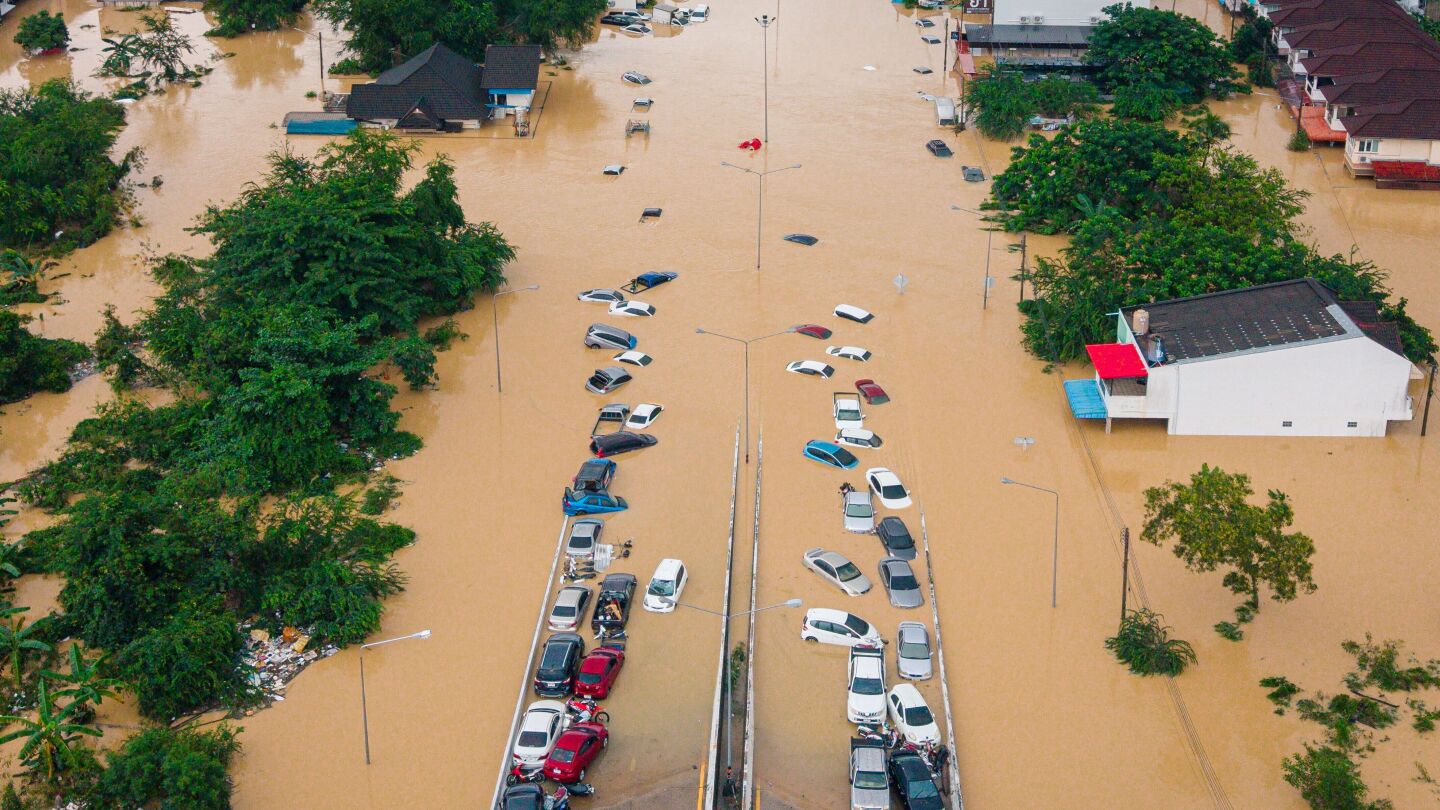
Families in southern Thailand perch on rooftops to escape flooding that has killed at least 33
Southern Thailand is reeling from catastrophic flooding that has claimed at least 33 lives and impacted over 2.7 million people across 12 provinces, according to officials. The disaster, triggered by relentless heavy rains, has left homes submerged, streets impassable, and thousands stranded on rooftops awaiting rescue. Dramatic footage captured by Thai PBS showed a family of five being rescued from their nearly submerged home in Hat Yai, the region’s largest city, highlighting the dire situation. Prime Minister Anutin Charnvirakul declared a state of emergency in Songkhla province, citing the “unprecedented severity” of the floods. While rainfall has begun to decrease, the Meteorological Department warned of continued heavy rains and flash flooding. Emergency response efforts are in full swing, with the Thai navy deploying its sole aircraft carrier, the HTMS Chakri Naruebet, as an offshore command center. The air force base at Bangkok’s Don Mueang airport has been designated as a staging area for relief operations. Hat Yai Hospital faces critical challenges, with 50 intubated patients airlifted to safety and plans underway to evacuate 600 others. The Public Health Ministry is also mobilizing mental health teams to support affected individuals and medical personnel.
-

‘My world, my rock’: Billionaire Richard Branson mourns wife’s death in heartfelt post
Renowned billionaire and Virgin Group founder Richard Branson has publicly mourned the passing of his beloved wife, Joan Templeman, in a deeply emotional Instagram post. Joan, who was 80 years old, had been Branson’s life partner for 50 years, and her death has left a profound void in his life. In his heartfelt tribute, the 75-year-old entrepreneur described Joan as ‘the most wonderful mum and grandmum,’ his ‘best friend, rock, guiding light, and world.’ The post was accompanied by a touching photograph of Joan, capturing the essence of their enduring love. The couple first met in 1976 when Joan was working in an antique shop, and Branson famously referred to their encounter as ‘love at first sight.’ Their relationship blossomed over the years, culminating in a 1989 wedding ceremony on Necker Island, a private island Branson purchased partly to impress her. The news of Joan’s passing has drawn an outpouring of condolences from celebrities, including Jennifer Lopez and Natalie Imbruglia, who praised Joan’s warmth and kindness. Branson’s tribute serves as a poignant reminder of their remarkable bond and the legacy she leaves behind.
-

At least four dead as fire engulfs Hong Kong tower blocks
A catastrophic fire erupted in Hong Kong’s Tai Po district on Wednesday afternoon, engulfing multiple high-rise buildings in the Wang Fuk Court housing complex. The blaze, which began at 14:51 local time, quickly escalated to a level four alarm within 40 minutes and was later upgraded to the highest level five by 18:22. Tragically, at least four people have lost their lives, including one firefighter, while three others are critically injured. Local media, citing former district councillor Herman Yiu Kwan-ho, reported that 13 individuals, including eight elderly residents and two infants, remain trapped in the inferno. Additionally, 14 pet cats are also believed to be stranded. The fire’s rapid spread is attributed to bamboo scaffolding surrounding the buildings, a common but increasingly scrutinized construction practice in Hong Kong. Authorities have established temporary shelters and assistance hotlines to support affected residents. The incident has left the community in shock, with the full extent of the damage yet to be determined.
-

A devastating fire destroys a crowded slum and leaves thousands homeless in Bangladesh capital
A catastrophic fire tore through the densely populated Korail slum in Dhaka, Bangladesh, reducing 1,500 shanties to ashes and displacing thousands of residents. The blaze, which erupted on Tuesday evening, raged for 16 hours before being extinguished on Wednesday, according to Rashed Bin Khalid, a duty officer at the Department of Fire Service and Civil Defence. Fortunately, no casualties have been reported. Lieutenant Colonel Mohammad Tajul Islam Chowdhury, the fire service director, confirmed the extensive damage, emphasizing the plight of the now-homeless families. The Korail slum, home to approximately 60,000 families—many of whom are climate refugees—spans over 160 acres and is nestled between Dhaka’s affluent Gulshan and Banani neighborhoods. The fire, which produced thick smoke and engulfed the area overnight, left residents scrambling to salvage their belongings from the debris. Firefighters faced significant challenges in accessing the site due to the slum’s narrow alleys. Dhaka, a city of 10.2 million people, is riddled with slums where rural migrants, driven by poverty and climate disasters, seek refuge, often working in low-paying jobs such as rickshaw driving, housekeeping, and cleaning.
-

Turkish journalist jailed for four years for threatening Erdogan on social media
A Turkish court on Wednesday convicted veteran journalist Fatih Altayli of threatening President Recep Tayyip Erdogan, sentencing him to four years and two months in prison. The case, widely criticized as an attempt to stifle dissent, has drawn significant attention to the state of press freedom in Turkey. Altayli, 63, whose YouTube programs garnered hundreds of thousands of daily views, was detained in June and charged with publicly disseminating a threat against the president. He has denied the allegations and plans to appeal the verdict. The court ordered him to remain in custody during the appeals process, as reported by Cumhuriyet newspaper and other media outlets. The charges stem from a comment Altayli made on his program, “Fatih Altayli Comments,” following a poll indicating that over 70% of Turks opposed a lifetime presidency for Erdogan, who has ruled for more than two decades. Altayli remarked that he was unsurprised by the poll results, stating that the Turkish people historically prefer checks on authority. He referenced the Ottoman Empire, noting that sultans who lost public favor were often assassinated or forced into suicide. During the trial, Altayli called the accusations “absurd and unnecessary,” questioning why the president would fear him, as he has no ties to violent organizations. His YouTube program was suspended last month after the trial’s first hearing, though he continued to share news and commentary through letters relayed by his lawyers and read by his assistant. With most mainstream media in Turkey controlled by pro-government entities, independent journalists have increasingly turned to platforms like YouTube for uncensored reporting. According to the Turkish Journalists Syndicate, Altayli is among 11 journalists and media workers currently imprisoned in Turkey. The government maintains that these individuals are prosecuted for criminal acts, not their journalistic activities.
-

Deadly fire engulfs Hong Kong apartment blocks
A devastating fire broke out in a residential area of Hong Kong, engulfing multiple apartment blocks and sending thick plumes of smoke into the sky. Dramatic video footage captured the scene as firefighters, perched on cranes, battled the intense blaze in a desperate attempt to bring it under control. The fire, which erupted unexpectedly, has resulted in multiple fatalities, though the exact number of casualties remains unclear. Authorities are investigating the cause of the inferno, while emergency services continue to work tirelessly to ensure the safety of residents and prevent further damage. The incident has left the community in shock, raising concerns about fire safety measures in densely populated urban areas.
-

Track-laying for Harbin-Yichun high-speed railway completes
The Harbin-Yichun high-speed railway, a pivotal infrastructure project in Northeast China, has reached a significant milestone with the completion of its track-laying phase on Tuesday, November 25, 2025. This development marks a crucial step forward in the construction of China’s northernmost high-speed railway. The project, which spans Heilongjiang province, is set to enhance regional connectivity and boost economic growth in the area. An aerial drone photo captured on November 25, 2025, showcases the construction site in Qing’an county, highlighting the progress made. The Harbin-Yichun high-speed railway is expected to significantly reduce travel time between the two cities, fostering greater integration and development in the region. This achievement underscores China’s commitment to advancing its high-speed rail network, which is already the most extensive in the world.
-

Harbin’s winter wonderland takes shape with record use of ice and snow
As winter descends upon Northeast China, the city of Harbin is gearing up for its most spectacular ice and snow season yet. The construction of the 27th Harbin Ice and Snow World, a premier winter attraction, officially commenced on Tuesday, November 25, 2025. This year’s edition promises to be the largest in history, spanning an impressive 1.2 million square meters. To ensure an early opening, 200,000 cubic meters of ice harvested from the frozen Songhua River last winter have been meticulously preserved using a combination of traditional ice-storage techniques and modern insulation methods. These blocks, free from the air bubbles found in man-made ice, are essential for the intricate carvings and structures that define the park. The first batch of ice will be used to construct the park’s centerpiece, the super ice slide, and the main tower. Harbin Ice and Snow World Co has employed advanced technology to maintain the ice’s integrity, even during the scorching summer months when temperatures soared above 30°C. This year’s park is set to be a winter wonderland like no other, attracting visitors from across the globe to experience the magic of Harbin’s icy artistry.
-

Cop shields public from scammers
In the dynamic landscape of Beijing, where tradition meets modernity, a silent war against telecom fraud is being waged. Unlike traditional crimes, these offenses are orchestrated through deceptive online profiles, fraudulent investment apps, and persuasive phone calls. At the forefront of this battle is Xing Yunwei, a seasoned anti-fraud officer from Beijing’s Shijingshan district, who has dedicated nearly five years to protecting citizens from financial predators. Xing’s journey began in a local police station, handling conventional crimes like burglaries and street altercations. However, the surge in internet and telecommunication usage around 2020 marked a pivotal shift in his career. As telecom fraud cases skyrocketed, Xing was selected to join the district’s newly established anti-fraud center. ‘It was like learning a whole new job,’ Xing remarked, highlighting the challenges of tracking scammers who operate remotely, often from different provinces or even countries. Beyond his investigative prowess, Xing’s approach combines empathy and patience, offering reassurance to victims and helping them rebuild their lives after financial losses. His efforts have not only safeguarded countless individuals from scams but also shed light on the evolving nature of crime in the digital age.