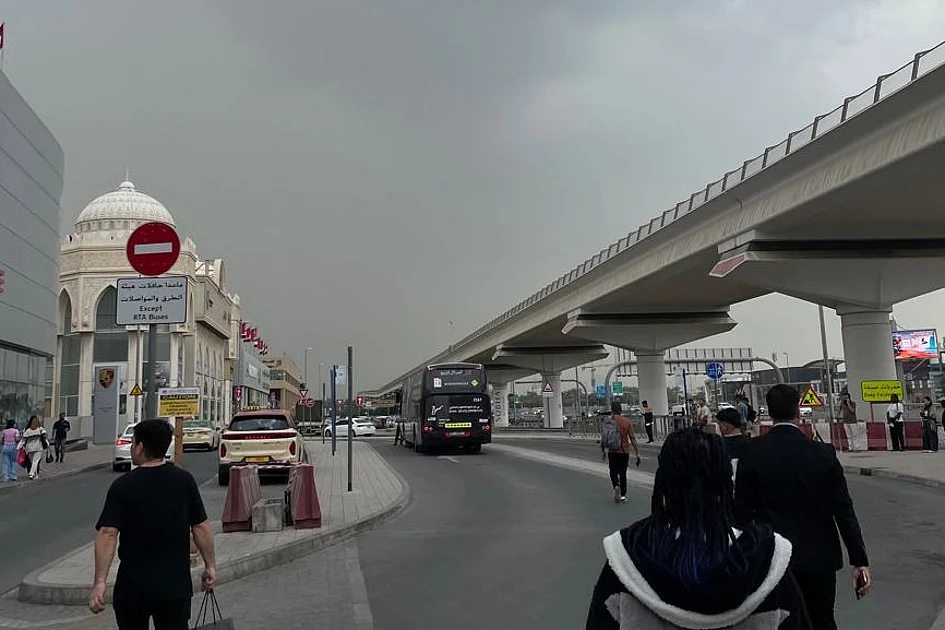
Dubai’s daily commuters have been taken aback by the sudden appearance of new solid-line road markings on major routes such as Ittihad Road, Baghdad Street, the Airport Tunnel, E311, and E611. These ‘no passing lines,’ designed to regulate traffic flow, have left many drivers struggling to adapt, resulting in unexpected fines. The markings, which are positioned close to exits, have made quick lane changes difficult for motorists accustomed to the previous patterns. According to the Roads and Transport Authority (RTA), these continuous white lines prohibit overtaking, lane switching, or turning, and violations incur penalties. Residents like Basha S, who frequently use these roads, have expressed frustration over the lack of prior notice or signage. Basha recently received a Dh400 fine for overtaking on one of the new lines, stating that the markings appeared suddenly without warning. Similarly, C George, a commuter on E311, was fined after unintentionally crossing a solid line near Exit 63. While some drivers acknowledge the safety benefits of the new system, they have called for clearer communication and advance warnings to help them adjust. Ahmed Salah, a daily driver on Airport Tunnel Road, emphasized the need for signage indicating ‘no lane change ahead’ to prevent fines and confusion. Motorists have urged authorities to provide better guidance as the new markings are rolled out, stressing that while safety measures are welcome, smoother implementation is essential.
分类: society
-

Mayors, city planners explore Nanjing
Nanjing, the capital of Jiangsu Province, recently hosted a gathering of mayors and city planners from across the globe to exchange insights on green transformation, cultural heritage preservation, and smart governance. The event, held on Wednesday, highlighted Nanjing’s commitment to sustainable urban development and its rich historical legacy. Participants visited Yuhuatai High School to witness a campus soccer match, showcasing the city’s emphasis on youth engagement and sports infrastructure. Nanjing’s dedication to fostering a soccer culture was evident in its 294 national youth campus soccer specialty schools and the construction of 180 new soccer fields over the past five years. Alessandro Rapinese, Mayor of Como, Italy, praised Nanjing’s energy and competitiveness, which he experienced firsthand on the soccer field. The delegation also explored the Nanjing City Wall Museum and Zhonghua Gate Wengcheng, marveling at the city’s meticulous preservation of its Ming Dynasty heritage. The Nanjing City Wall, built in 1366, remains the world’s longest and best-preserved ancient city wall, while Zhonghua Gate Wengcheng stands as a testament to China’s architectural ingenuity. Over the three-day visit, participants embarked on a diverse itinerary, including a research vessel tour to observe finless porpoises, a visit to a bug studio to study insect traces, and a tour of Nanjing Iron and Steel Group Company to witness its green transformation efforts. The event also featured a World Literature Salon, where mayors read Chinese and English poetry, fostering cross-cultural dialogue. Mohamed Higazy, a board member of the Egyptian Council for Foreign Affairs, lauded Nanjing as a model city that balances heritage preservation with forward-looking development. Thomas Himmler, Director of Foreign Affairs in Dietfurt, Germany, expressed his admiration for Nanjing’s warmth and cultural richness, emphasizing his goal to bridge understanding between Germany and China.
-

Philippine court convicts dismissed town mayor, allegedly a Chinese, of human trafficking charges
A Philippine court has handed down a life sentence to Alice Guo, a former mayor accused of being a Chinese national, for her involvement in a large-scale human trafficking and online scam operation. The Pasig City Regional Trial Court in metropolitan Manila convicted Guo and seven other Filipino and Chinese co-accused, imposing a fine of 2 million pesos ($34,000) each and ordering compensation for trafficking victims. Guo, who denies all allegations and claims Filipino citizenship, allegedly facilitated the establishment of an illegal online gaming complex in northern Tarlac province, where hundreds of foreign nationals were forced to conduct financial scams. The court revealed that the operation used parcels of land and buildings to house trafficked workers, coercing them into fraudulent activities. This case highlights the growing issue of online scam centers in Southeast Asia, particularly in border areas like Cambodia, Laos, and Myanmar, where hundreds of thousands have been trapped in virtual slavery. Philippine President Ferdinand Marcos Jr. has taken steps to combat these operations, banning hundreds of Chinese-run online gaming businesses linked to crimes such as financial scams, human trafficking, and kidnapping. While many centers have been raided and shut down, officials acknowledge that more remain operational. Senator Risa Hontiveros, who led Senate inquiries into the scam operations, hailed Guo’s conviction as a victory against transnational crimes but emphasized that the fight is far from over. Hontiveros also raised concerns about potential espionage activities linked to Chinese nationals operating these centers, amid escalating territorial conflicts between China and the Philippines in the South China Sea. Guo, dismissed from her mayoral post last year for grave misconduct, fled to Indonesia but was arrested and deported back to the Philippines, where she remains in detention.
-

Woman with pink nail polish versus wild — and both win
In a striking juxtaposition of glamour and grit, Yang Chaoqin, a 29-year-old engineering graduate, recently captivated audiences by participating in the Zhangjiajie Qixing Mountain Wilderness Survival Challenge. Known as ‘Leng Meiren’ (Cold Beauty), Yang arrived at the rugged Qixing Mountain in early October with pink nail polish and full makeup, including false eyelashes. Over the course of 30 days, she transformed into a seasoned survivalist, living in a mountain cave and enduring the harsh autumn chill of the forest. Her journey, marked by moments like eating a locust whole and calmly declaring it a source of protein, has become a sensation on Chinese social media. The challenge, which began on October 9 with 100 contestants, emphasizes harmony with nature, requiring participants to build shelters, make fires, and forage for food. The event has garnered unprecedented attention, with official channels on platforms like Douyin and Kuaishou amassing millions of followers and over 12 billion views by mid-November. Even Bear Grylls, host of the global hit ‘Man vs. Wild,’ praised the challenge on the organizers’ Douyin channel, calling it ‘epic’ and commending the contestants. The Zhangjiajie Qixing Mountain Wilderness Survival Challenge has carved out a unique niche, blending traditional survival skills with a distinctly Chinese cultural perspective.
-

Trains collide in the Czech Republic, leaving dozens of people injured
A significant train collision occurred in the southern Czech Republic on Thursday morning, resulting in multiple injuries and disrupted rail services. The incident took place near Ceske Budejovice at approximately 6:20 a.m., involving an express train and another passenger train. According to the regional rescue service, 57 individuals sustained injuries, with two reported to be in serious condition. However, a local hospital in Ceske Budejovice later revised this figure, stating that five of the admitted patients had serious injuries. The collision led to the suspension of rail traffic between Ceske Budejovice and Plzen, with services not expected to resume until the afternoon. Authorities have launched an investigation to determine the cause of the crash, which has raised concerns about rail safety in the region.
-

Education on legal matters strengthened
In a bid to make legal education more engaging and accessible, China has introduced innovative programs tailored for young students and the elderly. These initiatives aim to deepen public understanding of the law and foster a culture of legal awareness. One such program, organized by the Haidian District People’s Court in Beijing, recently saw high school students participate in an immersive legal workshop. Students took on roles as plaintiffs, defendants, and judges to navigate a simulated inheritance dispute, learning about the Civil Code and judicial procedures in the process. The workshop, guided by court assistant Sun Jiayun, emphasized the importance of hands-on learning to spark interest in legal concepts. This initiative is part of a broader transformation in China’s legal education system, driven by the implementation of Xi Jinping Thought on the Rule of Law. President Xi Jinping has called for intensified efforts to advance the rule of law across all sectors, emphasizing the need for society-wide observance of the law. The program’s success highlights the potential of interactive methods to make legal education more relatable and effective, particularly for younger audiences.
-

1,700 years ago, bishops and an emperor wrote a creed. Millions still recite it in church
The Council of Nicaea, convened 1,700 years ago in present-day Turkey, remains a cornerstone of Christian history, symbolizing both unity and division within the faith. This historic gathering, orchestrated by Roman Emperor Constantine in 325 AD, produced the Nicene Creed, a foundational statement of Christian belief still recited by millions worldwide. Pope Leo XIV’s visit to the site on November 28, as part of his first major foreign trip, underscores its enduring significance. The council marked the first ecumenical meeting of bishops, addressing theological disputes, particularly the “Trinitarian Controversy,” which centered on the relationship between God the Father and Jesus the Son. Despite later schisms, the Nicene Creed remains a unifying document for Catholic, Orthodox, and most Protestant denominations. The anniversary has been commemorated globally, with events ranging from the World Council of Churches’ celebration in Egypt to local gatherings in the U.S. The council’s legacy, however, is complex. While it achieved theological compromise, it also institutionalized antisemitism and failed to permanently resolve doctrinal conflicts. Arius, whose teachings were condemned at Nicaea, later regained influence, and debates persisted for generations. Subsequent councils, such as the one in Constantinople in 381, expanded the creed, but divisions continued, including the Great Schism between the Catholic and Eastern Orthodox churches in the 11th century. Despite these fractures, the anniversary serves as a reminder of Christianity’s call to unity, offering hope for reconciliation in a divided church.
-

Passport delay saved wife of UAE expat who died in Saudi bus crash
In a tragic yet fateful turn of events, Abdul Gani Shirahatti, an Indian expatriate who had lived and worked in Abu Dhabi for nearly two decades, was among the 45 pilgrims who lost their lives in a devastating bus crash in Saudi Arabia. The accident occurred on Monday during a journey from Makkah to Madinah, where the bus collided with a tanker. Gani, a dedicated hotel driver for 18 years, had embarked on a short Umrah pilgrimage, a journey he had undertaken alone after his wife’s passport delay prevented her from accompanying him. His son and elder brother, Farook, traveled to Madinah to provide DNA samples to identify Gani’s remains, a process that has left the family in profound grief. Gani’s wife, who narrowly escaped the tragedy due to the passport delay, is now grappling with the loss of her husband. The family, supported by friends and authorities, awaits the completion of formal identification procedures. Gani, described as a hardworking and devoted family man, had planned to return to India for a long-awaited reunion with his loved ones after completing his pilgrimage and work responsibilities. Instead, his family now mourns his untimely death, remembering his unwavering commitment to providing for his wife, three daughters, and son.
-

She plays ‘Amazing Grace’ in the most remote practice room on Earth
In the icy expanse of Antarctica, where the frigid air bites at exposed skin, Natalie Paine, a French horn player in New Zealand’s navy, has found an unlikely stage. Since October, Paine has been stationed at Scott Base, one of 21 military members supporting scientific research on the frozen continent. Her melodies, carried across the Ross Sea, emerge from what might be the most remote practice room on Earth. ‘It’s beautiful and very inspiring,’ Paine shared with the Associated Press. ‘I’ll sit by the window, play music in my limited free time, and let the surroundings fuel my creativity.’
Paine’s journey to Antarctica is as unconventional as her current role. Growing up in the arid climate of Adelaide, Australia, she once dreamed of visiting the frozen continent as a scientist. However, her path led her to study music at university, temporarily shelving her Antarctic aspirations. Years later, as a musician in New Zealand’s navy, she discovered that military personnel, including musicians, could be stationed in Antarctica. ‘My eyes lit up,’ Paine recalled. ‘I asked, even a musician? And my instructor said, heck yeah, why not?’
Realizing this dream was no easy feat. It took four years of persistent applications before Paine secured a posting as a communications operator. Her demanding job, involving six-day shifts monitoring radio, phone, and email communications, leaves little time for music. Yet, Paine carves out moments to practice, often retreating to a historic hut built in 1957 under the leadership of explorer Sir Edmund Hillary. There, she plays her jHorn, a lightweight, durable plastic instrument designed for children, which is better suited to the harsh Antarctic climate than her traditional French horn.
Despite the challenges, Paine’s presence has brought joy to Scott Base. She has performed live at ceremonies, replacing the usual recorded music, and even braved sub-zero temperatures to deliver a solo concert at minus 21 degrees Celsius. ‘Music is the universal language,’ Paine reflected. ‘It reminds us that we’re all connected, whether we’re on the ice or back home.’ Her story is a testament to the power of perseverance, adaptability, and the unifying force of music in even the most extreme environments.
-

An anti-migrant group in South Africa is blocking foreigners from health clinics
In the early hours of the morning, Tholakele Nkwanyana and members of Operation Dudula, a South African anti-immigrant group, gather at the Diepsloot public health clinic in Johannesburg. Their mission is not to seek medical care but to prevent foreigners from accessing it. Dressed in military-style attire, they block the clinic’s entrance, demanding identity documents and turning away mothers with children and the sick, directing them to private hospitals that charge fees. This scene has become increasingly common across Gauteng, South Africa’s most populous province, as healthcare becomes the latest flashpoint in the nation’s contentious immigration debate. Despite a Johannesburg High Court order to cease harassing migrants, Operation Dudula vows to appeal, claiming their actions prioritize South Africans amid a perceived overburdening of resources. South Africa, Africa’s most developed economy, attracts migrants from neighboring countries like Zimbabwe, Mozambique, and Lesotho, as well as from Nigeria and Ethiopia. In the year ending March 31, nearly 47,000 undocumented migrants were deported, an 18% increase from the previous year. Operation Dudula, which has grown in visibility, has also targeted foreign-owned businesses and schools, accusing migrants of exacerbating South Africa’s 31% unemployment rate. The group’s organized structure, including regional leaders and public engagements, hints at potential political ambitions. South Africa’s government condemns these actions, emphasizing that healthcare is a universal right. However, police resources are stretched thin in a country with high crime rates, limiting their ability to protect clinics. Recent arrests of Operation Dudula members in Soweto highlight the group’s aggressive tactics. The South African Human Rights Commission warns of a global rise in anti-immigrant sentiment, urging against scapegoating migrants for systemic healthcare failures. South Africa spends 8.5% of its GDP on healthcare, yet faces overcrowded hospitals, medication shortages, and crumbling infrastructure. Meanwhile, migrants like Blessing Tizirai and Nonhlanhla Moyo, who fled Zimbabwe’s collapsed public health system, face life-threatening barriers to care. As tensions escalate, Zimbabwe’s government refuses to fund its citizens’ treatment in South Africa, even as its political elite seek medical care abroad.