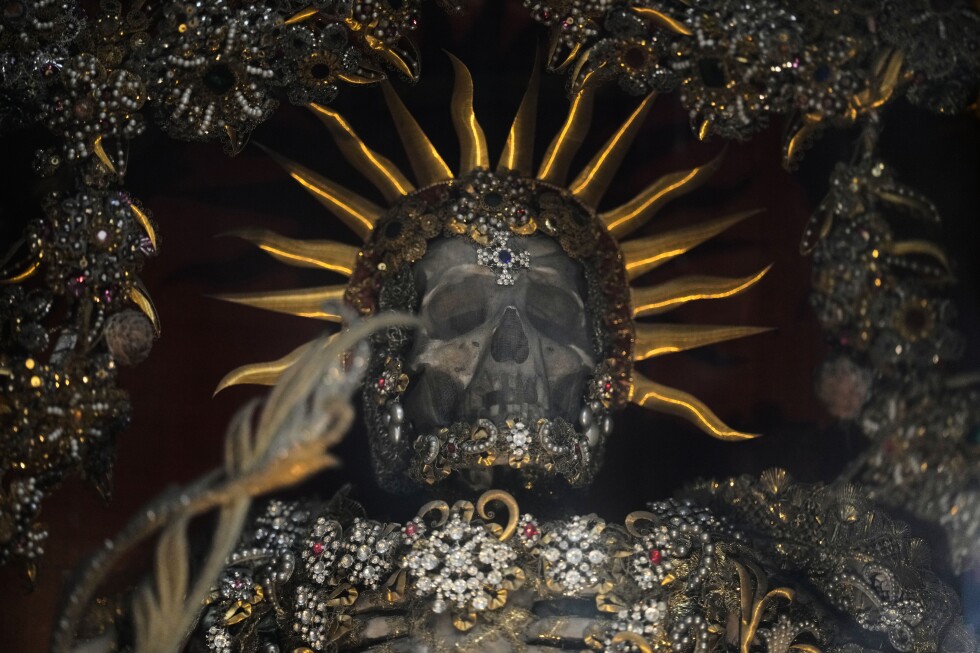
In the ornate Baroque Catholic monastery church of Banz, nestled near the Bavarian town of Bad Staffelstein in southern Germany, a striking, centuries-old exhibit continues to draw curiosity and quiet unease from visitors: four fully intact skeletons, draped in luxurious silk and brocade, embellished with gemstones, delicate filigree gold, silver and fine lace. These remains, known by the names Vincenzius, Valerius, Benedictus and Felix Benedictus, count among Europe’s little-known collection of catacomb saints, a set of religious relics with a unique history stretching back hundreds of years.
These holy skeletons were transported from Roman catacombs to the Benedictine monastery between the late 17th century and mid-18th century, a period when demand for early Christian martyr relics boomed across Catholic Europe. For many first-time visitors, the display is unsettling. “It’s actually a little creepy,” church custodian Anita Gottschlich shared quietly, standing before one skeleton whose hollow eye sockets seem to lock gaze with onlookers. Even so, Gottschlich notes the relics hold enduring cross-generational fascination: older guests who first saw the skeletons as children still make a point to seek out what locals call the Holy Bodies, their memories of the display undimmed after decades.
While catacomb saints may be unknown to many modern travelers, their decorated remains can still be found in dozens of Baroque churches and monasteries across Bavaria, as well as in neighboring Austria, Switzerland, Czechia and their native Italy. Most are permanently displayed in glass, coffin-style cabinets, keeping the long-dead relics accessible to visitors centuries after they arrived.
The story of catacomb saints begins in 16th century Rome, when excavators uncovered thousands of unmarked graves in the city’s ancient underground catacombs. Church leadership quickly classified all uncovered remains as early Christian martyrs, making them desirable relics for churches and monastic communities across the continent. “At the time, the church simply designated them all as saints,” explained Walter Ries, the Catholic priest who serves the Banz church congregation today. “And of course, in many countries, including Germany, people wanted to have such holy remains, such relics, simply because this enhanced the status of their own church or monastery and perhaps turned it into a place of pilgrimage.”
Banz Monastery itself has changed dramatically since the four skeletons arrived. Founded by Benedictine monks in 1070, the community flourished for more than 700 years before it was dissolved in 1803 during widespread German secularization. Today, only the church remains an active place of worship, housing a small congregation of just 211 people, while the former monastery buildings are occupied by a political foundation. “A great deal has changed over the course of the centuries,” Ries said. “Back then, these relics were very important, but today they really aren’t anymore.”
The surge in devotion to catacomb saints in the 17th and 18th centuries emerged from a period of profound crisis in central Europe. Just decades before the Banz skeletons arrived, the region was still recovering from the Thirty Years’ War, a brutal conflict that began as a religious struggle between Catholics and Protestants and killed an estimated 4 to 8 million people through combat, famine and widespread disease. “That was a terrible time,” Ries said. “And so people tried to open the gates of heaven through the Baroque. That’s why everything was designed so beautifully. It was an escape from the present, which was often so terrible. That’s also why these eerie skeletons were so beautifully draped and depicted as lifelike as possible.”
Abbots of Banz Monastery sent official delegations to Rome twice, first in 1680 and again in 1645, to secure the four relics. After their arrival, nuns from the nearby town of Bamberg spent hours carefully adorning the skeletons in the lavish textiles and finery they still wear today.
To this day, the Holy Bodies are only put on full public display for special religious occasions including All Saints’ Day. For most of the year, wooden panels painted with portraits of the saints cover the glass display cases, turning a rare viewing into a meaningful experience for faithful visitors. According to Günter Dippold, a historian who has spent years researching both catacomb saints and the history of Banz Monastery, the elaborate decoration of the skeletons serves a specific theological purpose that many modern visitors miss.
The adornment “is not meant to show the dead body of a saint, but rather to show his glorified body,” Dippold explained. “It is therefore intended to show the faithful who view it what we will look like after the resurrection, after being raised from the dead, when we no longer have our earthly bodies but rather glorified ones.”
—
This report is part of Associated Press religion coverage, supported through a collaboration with The Conversation US via funding from Lilly Endowment Inc. The AP holds sole responsibility for all content.