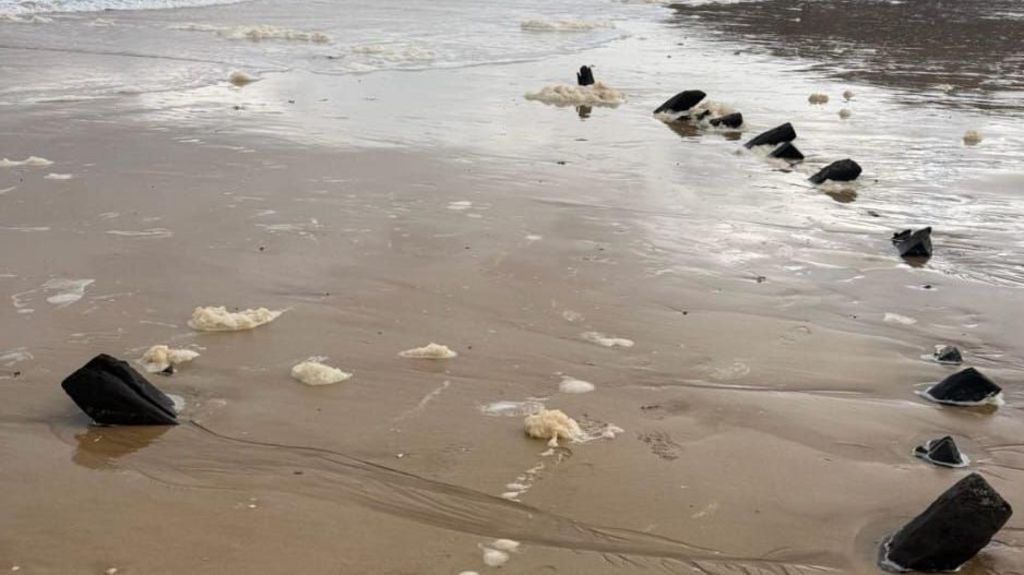
Recent powerful coastal storms in Ireland’s County Donegal have potentially solved a 213-year-old maritime mystery. Extraordinary wind patterns at Ballymastocker Bay have shifted substantial sand deposits, exposing what archaeologists believe could be the long-lost remains of HMS Saldanha—a British naval frigate that tragically sank during a violent December storm in 1811 with all 253 crew members aboard.
The uncovered wooden structure, visible during low tide conditions, has generated significant excitement within the local community and archaeological circles. According to maritime archaeologist John O’Raw, who has studied the Saldanha wreck for decades, the exposed timbers likely represent the vessel’s starboard bow section. “These structures protruding from the sand are probably futtocks,” O’Raw explained, “which are individual curved timber components that constitute the ribs or frames of a traditional wooden ship’s hull.”
Historical records indicate HMS Saldanha was performing blockade duties against French forces during the Napoleonic Wars when it encountered catastrophic weather conditions. Seeking shelter in Lough Swilly, the 36-gun frigate reportedly struck cliffs south of Portsalon before breaking into multiple sections. Contemporary accounts suggest only the captain’s parrot survived the disaster, though historians note many original newspaper reports contained significant inaccuracies.
The potential discovery has particular resonance for local residents who have maintained the memory of the tragedy through memorial efforts. In 2011, community members raised €1,500 to erect a monument honoring the lost sailors, and a commemorative plaque bearing crew members’ names was subsequently unveiled using archival records from London.
Journalist Anne Cadwallader, who has helped organize memorial events, noted the emotional significance: “These men entered freezing cold water in blustering gales. One can only imagine their horrors, and not a single survivor emerged. It’s hardly surprising that stories and legends grew around this wreck.”
The National Monuments Service has conducted preliminary inspections and documentation of the site, acquiring precise locational data for their Wreck Inventory of Ireland Database. While officials caution that definitive identification requires further analysis and dating of the timber, they plan additional comprehensive recording sessions in March when tidal conditions permit extended site access.
The Saldanha’s legacy extends beyond the human tragedy—its sinking directly prompted construction of the iconic Fanad Lighthouse, which began illuminating Lough Swilly’s hazardous waters in 1817 and continues operation today. The ship’s anchor, recovered earlier by local fishermen, remains displayed at Fort Dunree Military Museum, serving as a tangible connection to one of Ireland’s most enduring maritime mysteries.